06 Waitqueue
We could have read and write to the driver already, but the CPU will not happy if we do read and write continously and not reasonally. Sometimes the device buffer is full and not ready to accept data or it is processing data and not ready to send. In such cases, driver should (by default) block the process, putting it to sleep until the request can proceed.
There are several ways of handling sleeping and waking up in Linux, each suited to different needs. Waitqueue is also one of the methods to handle that case.
The waitqueue is a queue that its elements is waitting :).
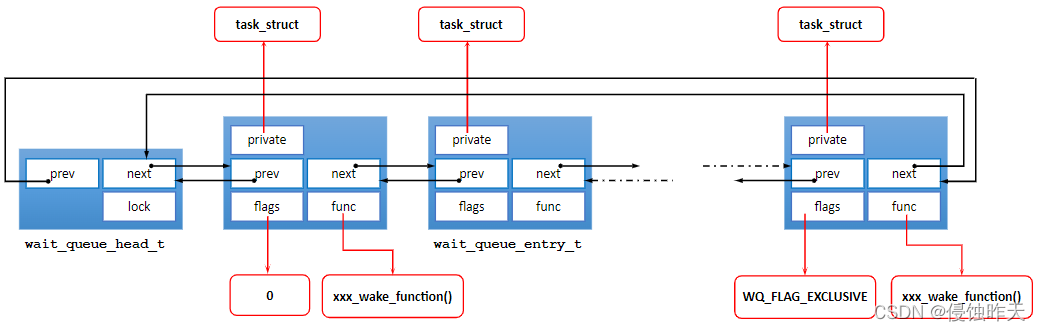
To make a process sleep, just put it into waitqueue. However, a couple of rules that you must keep in mind to be able to code sleeps in a safe manner(avoiding race condition):
- Never sleep when you are running in an atomic context.
An atomic context is simply a state where multiple steps must be performed without any sort of concurrent access. What that means, with regard to sleeping, is that your driver cannot sleep while holding a spinlock, seqlock, or RCU lock.
- Things have changed while process is sleeping, so we have to check our condition after wake up.
There are 3 important steps in Waitqueue:
- Initializing Waitqueue
- Queuing (Put the Task to sleep until the event comes)
- Waking Up Queued Task
Waitqueue is defined in <linux/wait.h> with a structure of type wait_queue_head_t. A wait queue head can be defined and initialized statically or dynamically:
- Statically:
DECLARE_WAIT_QUEUE_HEAD(name); - Dynamically:
wait_queue_head_t my_queue;
init_waitqueue_head(&my_queue);
There are several macros are used to put process to waitqueue:
wait_eventwait_event_timeoutwait_event_cmdwait_event_interruptiblewait_event_interruptible_timeoutwait_event_killable
wait_event
Sleep until a condition gets true.
wait_event(wq, condition);
wq– the waitqueue to wait oncondition– a C expression for the event to wait for
Processes are put by wait_event is TASK_UNINTERRUPTIBLE.
wait_event_timeout
Sleep until a condition gets true or a timeout elapses
wait_event_timeout(wq, condition, timeout);
wq– the waitqueue to wait oncondition– a C expression for the event to wait fortimeout– timeout, in jiffies (same as tick in RTOSes)
Processes are put by wait_event is TASK_UNINTERRUPTIBLE.
If the timeout expires before the condition is met, the process is woken up regardless of the condition’s state. The return value indicates whether the condition was met or if the timeout occurred.
Return Value
The macro returns the number of jiffies remaining before the timeout expires. If the condition was met before the timeout, it returns a positive value (the remaining time). If the timeout expired, it returns 0.
wait_event_cmd
Sleep until a condition gets true
wait_event_cmd(wq, condition, cmd1, cmd2);
wq– the waitqueue to wait oncondtion– a C expression for the event to wait forcmd1– the command will be executed before sleepcmd2– the command will be executed after sleep
Processes are put by wait_event is TASK_UNINTERRUPTIBLE.
wait_event_interruptible
Sleep until a condition gets true, with the added capability of allowing the wait to be interrupted by signals.
This is particularly useful in scenarios where you want to wait for an event but also want to ensure that the process can be woken up by user-space signals (like SIGINT or SIGTERM).
wait_event_interruptible(wq, condition);
wq– the waitqueue to wait oncondtion– a C expression for the event to wait for
Processes are put by wait_event is TASK_INTERRUPTIBLE.
The return value will indicate that the wait was interrupted by a signal.
Return Value
- The macro returns 0 if the condition evaluated to true and the process was woken up normally.
- If the wait was interrupted by a signal, it returns
-ERESTARTSYS, which indicates that the system call was interrupted and should be restarted.
wait_event_interruptible_timeout
Sleep until a condition gets true or a timeout elapses, with the added capability of being interrupted by signals.
wait_event_interruptible_timeout(wq, condition, timeout);
wq– the waitqueue to wait oncondition– a C expression for the event to wait fortimeout– timeout, in jiffies (same as tick in RTOSes)
Processes are put by wait_event is TASK_INTERRUPTIBLE.
The return value indicates whether the condition was met or if the timeout occurred.
Return Value
- The macro returns the number of jiffies remaining before the timeout expires. If the condition was met before the timeout, it returns a positive value (the remaining time).
- If the timeout expired, it returns 0.
- If the wait was interrupted by a signal, it returns
-ERESTARTSYS, indicating that the system call was interrupted and should be restarted.
wait_event_killable
Sleep until a condition gets true. It also allow the wait to be interrupted by signals. This is similar to wait_event_interruptible, but it is specifically designed to handle situations where you want to ensure that the process can be killed (terminated) if a signal is received.
wait_event_killable(wq, condition);
wq– the waitqueue to wait oncondition– a C expression for the event to wait for
Processes are put by wait_event is TASK_KILLABLE.
If the signal that interrupts the wait is a termination signal (like SIGKILL or SIGTERM), the process will be terminated by the kernel.
The return value will indicate that the wait was interrupted by a signal.
Return Value
- The macro returns 0 if the condition was met and the process was woken up normally.
- If the wait was interrupted by a signal, it returns -ERESTARTSYS, which indicates that the system call was interrupted and should be restarted.
To wake processes in waitqueue, we can use the below function:
wake_upwake_up_allwake_up_interruptiblewake_up_syncandwake_up_interruptible_sync
wake_up
Wakes up only sleeping processes which are in non-interruptible sleep.
wake_up(&wq);
wq– the waitqueue to wake up
wake_up_all
Wakes up all sleeping processes, regardless of whether they are in interruptible or non-interruptible sleep.
wake_up_all(&wq);
wq– the waitqueue to wake up
wake_up_interruptible
Wakes up only sleeping processes which are in interruptible sleep.
wake_up_interruptible(&wq);
wq– the waitqueue to wake up
wake_up_sync and wake_up_interruptible_sync
Normally, when calling wake_up can cause an immediate reschedule to happen, which could result in context switching to a different process before the current process (the one that called wake_up) continues execution. It may not make sense to perform a context switch because the current process is about to sleep anyway. So calling wake_up_sync and wake_up_interruptible_sync guarantees that current process runs.
wake_up_sync(&wq);
wake_up_interruptible_sync(&wq);
wq– the waitqueue to wake up
The awakened processes could run immediately on a different processor, so these functions should not be expected to provide mutual exclusion. To avoid this situation, additional synchronization mechanisms (like spinlocks or mutexes) should be used.
Our code
The code located in folder 06_wait_queue
# To build ko driver
make build-06
# To clean ko driver
make clean-06
# To upload ko driver to our board
make upload-06
Result
[root@luckfox root]# insmod wq.ko
[root@luckfox root]# dmesg | tail -5
[27577.170630] 8
[27633.778206] Wq driver initializing...
[27633.782324] Thread Created successfully
[27633.782349] Wq module inserted successfully.
[27633.784268] Waiting For Event...
[root@luckfox root]# ls /dev/ | grep wq
wq_dev
[root@luckfox root]# cat /dev/wq_dev
[root@luckfox root]# cat /dev/wq_dev
[root@luckfox root]# cat /dev/wq_dev
[root@luckfox root]# cat /dev/wq_dev
[root@luckfox root]# dmesg | tail -5
[27862.400515] Wq File Opened...!!!
[27862.400627] Wq File Read
[27862.400648] Event Came From Read Function - 4
[27862.400657] Waiting For Event...
[27862.400672] Wq File Closed...!!!
I have created a thread, and put the thread into wait queue, every time we read the char device, it will unblock that thread with wait_event_interruptible, increase the read_count, and then reset the condition to 0.