01 Major and minor
Devices when connect to linux system located in /dev. Linux treats devices as files, so we call device files interchangeably.
Each device file has its own major and minor number(device files are created by device drivers). The major number identifies the driver associated with the device, while the minor number is used to distinguish between different devices or instances of the same type managed by that driver.
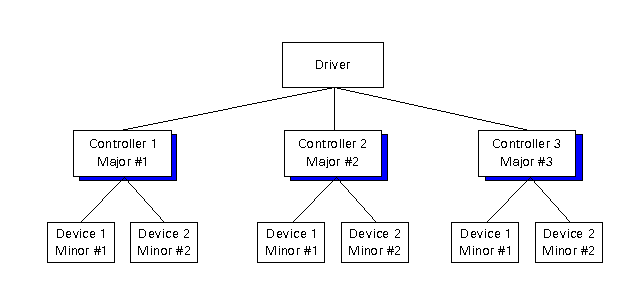
+---------------------+
|   User-Space App    |
|  (e.g., open /dev)  |
+----------+----------+
           |
+---------------------+
|     Device File     |
|  (e.g., /dev/fb0)   |
+----------+----------+
           |
+---------------------+
|     Major/Minor     |
|    (e.g., 250 1 )   |
+----------+----------+
           |
+---------------------+
|   Device Driver     |
|  (e.g., my_driver)  |
+----------+----------+
           |
+---------------------+
|       Hardware      |
|(e.g., oled display) |
+----------+----------+
- Device structure type: (defined in kernel header
<linux/types.h>)dev_t // contains both major & minor numbers - Macros: (defined in kernel header
<linux/kdev_t.h>)MAJOR(dev_t dev) // extracts the major number from dev MINOR(dev_t dev) // extracts the minor number from dev MKDEV(int major, int minor) // creates the dev from major & minor
We can allocate the major and minor numbers in two ways.
- Statically allocating
- Dynamically allocating
Statically allocating
This API (defined in kernel header <linux/fs.h>) registers the cnt number of device file numbers starting from first, with the name. Return 0 if the allocation was successfully.
int register_chrdev_region(dev_t first, unsigned int count, char *name);
Example
static dev_t first; // Global variable for the first device number
first = MKDEV(250, 1); // Major = 150, Minor = 1

register_chrdev_region(first, 1, "my_device"); // Register 1 device started from first dev with the name my_device
Dynamically allocating
If we don’t want the fixed major and minor numbers so use this method will allocate the major number dynamically to your driver which is available.
int alloc_chrdev_region(dev_t *dev, unsigned int firstminor, unsigned int count, char *name);
Example
static dev_t first; // Global variable for the first device number

alloc_chrdev_region(&first, 0, 1, "my_device"); // Alloc major number for first dev with 1 device, the minor number starts from 0 and the name is my_device
Unregister the Major and Minor Number
Regardless of how you allocate your device numbers, you should free them when they are no longer in use. Device numbers are freed with:
void unregister_chrdev_region(dev_t first, unsigned int count);
And usually, we should do this in the module’s cleanup function.
Our code
The code located in folder 01_major_and_minor
# To build ko driver
make build-01
# To clean ko driver
make clean-01
# To upload ko driver to our board
make upload-01
Result
- Statically
[root@luckfox root]# insmod mam.ko [root@luckfox root]# dmesg | tail -5 [ 5111.010099] 8 [ 5111.011428] 8 [ 5126.626149] 8 [ 5134.642838] Mam driver initializing... [ 5134.642870] Mam driver registered, Major 235, Minor 1 [root@luckfox root]# cat /proc/devices | grep mam 235 mam_dev - Dynamically
[root@luckfox root]# insmod mam.ko
[root@luckfox root]# dmesg | tail -5
[ 5134.642870] Mam driver registered, Major 235, Minor 1
[ 6436.434407] 8
[ 6454.953887] Mam driver unregistered
[ 6460.058224] Mam driver initializing...
[ 6460.058263] Mam driver registered, Major 242, Minor 0
[root@luckfox root]# cat /proc/devices | grep mam
242 mam_dev
[root@luckfox root]#